 ultimate-guide
Commercial Grade Sleeper Sofa Mechanism Durability Guide
Table of Contents
- What Makes a Sleeper Sofa Mechanism Commercial Grade?
- Square Tube Frame Benefits for Hospitality Furniture
- Comparing Mechanism Types: Bi-Fold vs. Pull-Out
- Commercial Furniture Weight Capacity Standards Explained
- How to Test a Sleeper Mechanism In-Store or On-Site
- Sleeper Sofa Mechanism Maintenance Tips for Longevity
- Conclusion
- Frequently Asked Questions
Last Updated: September 14, 2026
What Makes a Sleeper Sofa Mechanism Commercial Grade?
Commercial grade sleeper sofa mechanism durability comes down to three things: steel gauge, frame geometry, and cycle-tested components. A mechanism earns the "commercial grade" label when it is engineered for daily turnover in hospitality settings rather than occasional residential use.
This guide from Hospitality Sleeper draws on more than 35 years of building American-made mechanisms for hotels, resorts, and vacation rentals. Below, we break down what separates a mechanism that survives a decade of guest use from one that fails in year four.
Hospitality furniture lives a harder life than residential furniture: a guest room sofa may be opened daily, and a vacation rental several times a week. Commercial grade sleeper sofa construction accounts for that with heavier steel, reinforced pivot points, and locking systems that hold up under repeated load.
A commercial grade sleeper sofa mechanism is a steel folding system rated for high-frequency use in hospitality environments, built with heavier-gauge tubing and tested through thousands of open-and-close cycles. Residential mechanisms are typically rated for far lighter use and thinner materials.
Key Components of a Durable Mechanism
Every durable mechanism shares the same core parts. The frame carries the load. The pivot points handle the movement. The locking mechanism holds the bed open and folds it flat again.
- Square or rectangular steel tubing for the main frame, which resists twisting better than round tube
- Heavy-duty steel pivot points with welded or bolted reinforcement at stress junctions
- A positive locking mechanism that engages fully in both the open and closed positions
- An articulating joint system that distributes weight across the frame rather than concentrating it
- A glide system that lets the mechanism extend smoothly without binding
These parts fail as a system, not in isolation. A heavy frame paired with weak pivot hardware still fails; the mechanism only performs as well as its weakest joint.
Square Tube Frame Benefits for Hospitality Furniture
Square tube frames outperform round tube in one critical way: they resist torsional flex. When a guest sits on the edge of an open sleeper, square tubing distributes that force across flat surfaces instead of concentrating it at a single point.
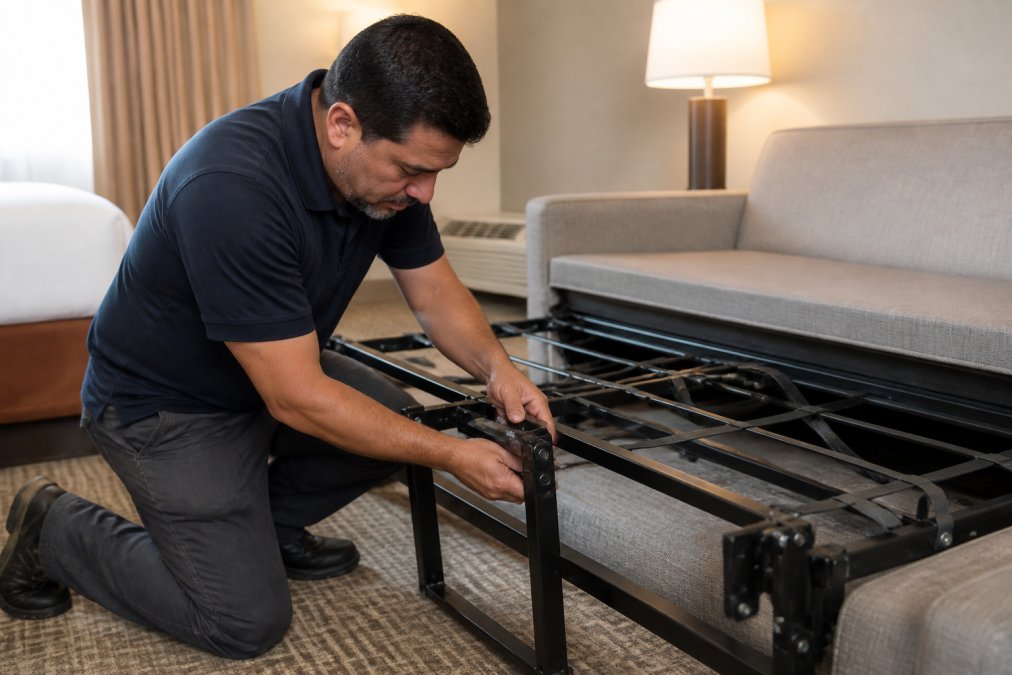
For hospitality furniture, that difference shows up over time: a frame that flexes less keeps its pivot points aligned, aligned pivots keep the locking mechanism engaging cleanly, and the whole system stays tighter for longer.
Square tube also welds more predictably than round tube, which matters at the corners, where most residential mechanisms develop cracks first.
The trade-off is weight, but that weight is an advantage for sofa stability: a heavier mechanism sits lower in the sofa and resists tipping when a guest leans on an open bed.
Comparing Mechanism Types: Bi-Fold vs. Pull-Out
The two dominant mechanism types behave differently under heavy use. A bi-fold mechanism folds the mattress in half and stores it compactly, while a pull-out mechanism extends the mattress on a sliding frame. Each has a place in contract furniture, but they fail in different places.
| Feature | Bi-Fold Mechanism | Pull-Out Mechanism |
|---|---|---|
| Storage footprint | Smaller | Larger |
| Mattress type | Folds in half | Lies flat |
| Frame stress | Concentrated at fold hinge | Spread across glides |
| Load path | Hinge carries the fold moment | Glides carry the sliding load |
| Best for | Tight spaces, frequent turnover | Standard rooms, guest comfort |
| Primary wear point | Fold hinge, spring tension | Glide system, locking mechanism |
| Typical failure mode | Hinge fatigue, spring sag | Glide binding, pivot misalignment |
Where Bi-Fold Mechanisms Fail
A bi-fold mechanism concentrates the entire fold moment at a single hinge line. Every time the bed opens, that hinge rotates through its full arc under the weight of the mattress and frame, and over thousands of cycles the hinge pin and its surrounding weld take the accumulated fatigue. When the hinge develops play, the mattress halves no longer align and the bed develops a ridge at the fold.
Bi-fold designs suit rooms where floor space is tight and housekeeping needs fast turnover, but the fold hinge needs inspection on a tighter schedule than any other component.
Where Pull-Out Mechanisms Fail
A pull-out mechanism spreads load across a glide system rather than concentrating it at one hinge. That is better for the frame, but it moves the wear point to the glides. Under heavy load, a worn or debris-clogged glide causes the frame to bind, and binding stresses the pivot points as the user forces the bed open. The failure chain runs glide first, pivot second, locking mechanism third.
Pull-out mechanisms favor guest comfort because the mattress lies flat with no fold ridge, and for extended-stay properties where guests sleep on the bed nightly, that flat surface and distributed load path generally hold up better over a long service life.
Matching Mechanism Type to Turnover Pattern
The right choice depends less on preference than on how often the bed actually moves. A room that opens the bed nightly puts the mechanism through a different duty cycle than one that opens it a few times a month.
- Nightly use, extended-stay: pull-out, because the flat mattress and distributed load path reduce per-cycle stress on any single joint.
- Occasional use, high-turnover housekeeping: bi-fold, because the compact footprint and fast fold speed matter more than long-cycle hinge life.
- Mixed use: pull-out with a reinforced glide system, and a hinge inspection schedule built around actual turnover.
Commercial Furniture Weight Capacity Standards Explained
Commercial furniture weight capacity standards describe how much static and dynamic load a mechanism is rated to carry. Static capacity measures a still load. Dynamic capacity measures a load in motion, which is the number that actually matters for a sleeper mechanism.
A mechanism rated for a high static load may still fail under a lower dynamic load, because the moving parts experience stress the static rating never captures. When you compare mechanisms, ask for the dynamic rating and the cycle count together.
The BIFMA furniture durability standards provide the framework most contract furniture is tested against, covering structural performance and repeated-use testing. For hospitality buyers, the relevant question is whether a mechanism has been tested to a cycle count that matches your property's turnover rate.
Cycle Testing: The Number Nobody Publishes
Most articles mention durability without ever naming a cycle count. A mechanism's real service life is expressed as open-and-close cycles, so the honest way to compare two mechanisms is to compare their tested cycle counts against your actual daily turnover.
Run the math on your own property. A mechanism that opens and closes twice a day accumulates roughly 730 cycles a year (bifma.org). One that opens and closes ten times a day accumulates about 3,650. Over a ten-year service life, that is the difference between roughly 7,300 cycles and roughly 36,500 cycles on the same mechanism. A mechanism engineered for the first number will not survive the second.
This is why cycle count, not static weight rating, is the specification that predicts failure. When a supplier cannot state a tested cycle count, treat the durability claim as unverified.
How Mechanism Weight Affects Sofa Stability
There is a second gap most guides skip: the relationship between mechanism weight and the stability of the sofa it sits in. A heavier mechanism lowers the sofa's center of gravity, which matters because an open sleeper bed extends the load far forward of the sofa's footprint, and a guest leaning on the foot of the bed creates a tipping moment the frame has to resist.
A heavier mechanism resists that tipping moment better than a light one: the same mass that makes a square tube frame harder to install also makes the open bed harder to tip.
The trade-off is floor contact: a heavier mechanism concentrates more load at the sofa's feet, increasing the risk of scratching and indentation on softer flooring. That is why heavy-duty mechanisms are often paired with wider, softer glides or protective foot pads.
A common mistake is specifying a mechanism by static weight capacity alone. A high static rating with no published cycle count tells you almost nothing about how the mechanism will hold up under daily hospitality turnover. Ask for the dynamic rating, the tested cycle count, and the floor-contact design together.
What to Ask a Supplier
- What is the tested open-and-close cycle count for this mechanism?
- What is the dynamic load rating, not just the static rating?
- How does the mechanism's weight affect the sofa's anti-tip stability?
- What floor-contact design protects against scratching under that weight?
Those four questions separate a mechanism built for hospitality turnover from one built for occasional residential use.
How to Test a Sleeper Mechanism In-Store or On-Site
Testing a mechanism takes about five minutes and tells you more than any spec sheet. Work through these steps in order to spot weak construction before it becomes a maintenance cost.
- Open and close the mechanism fully three times. Listen for grinding, popping, or uneven resistance.
- Check the locking mechanism engages firmly in the open position with no wobble.
- Press down hard on the foot of the open bed to test anti-tip stability.
- Rock the frame side to side to feel for torsional flex.
- Inspect the pivot points and welds for cracks, rust, or loose hardware.
- Confirm the glide system extends smoothly without binding.
For an on-site test of furniture already in service, open the bed and check the same points, then compare the resistance to a newer unit. A mechanism that has lost its spring tension will feel noticeably looser than a fresh one.
The American Hotel & Lodging Association tracks how much wear hospitality furniture absorbs across a typical property, which is why on-site testing matters more than showroom impressions. A mechanism that feels fine in a showroom may already be near the end of its service life after years of guest turnover.
Sleeper Sofa Mechanism Maintenance Tips for Longevity
Sleeper sofa mechanism maintenance tips come down to lubrication, inspection, and prompt repair of small failures. Most mechanism failures start as a minor issue that nobody addressed.
- Lubricate pivot points and articulating joints on a set schedule, not just when they squeak
- Inspect the locking mechanism monthly for full engagement
- Check frame reinforcement welds for hairline cracks during every deep clean
- Keep the glide system clear of debris, which causes binding and uneven wear
- Replace worn hardware before it damages the frame
Repairability matters as much as the schedule: a mechanism built with standard, replaceable parts can be serviced for years, while one built with proprietary or discontinued hardware becomes scrap the moment a single component fails.
That is where parts availability separates good mechanisms from disposable ones. Hospitality Sleeper builds mechanisms with replaceable components and backs them with a Lifetime Service Policy, so a worn pivot or locking part can be serviced instead of forcing a full furniture replacement.
Conclusion
The hard part of sourcing commercial grade sleeper sofa mechanism durability is proving it before you buy, not after year four. Spec sheets rarely tell the full story, and the mechanisms that fail earliest often looked fine on paper.
Hospitality Sleeper addresses that gap with American-made square tube frame mechanisms, more than 35 years of manufacturing experience, and a Lifetime Service Policy that keeps parts available long after installation. Our team also consults directly with procurement managers and furniture manufacturers to match mechanisms to your renovation schedule.
Get started with Hospitality Sleeper and specify mechanisms built to survive daily hospitality turnover, not just the showroom floor.
Frequently Asked Questions
What is the average lifespan of a commercial grade sleeper sofa mechanism?
A commercial grade sleeper sofa mechanism typically lasts 7 to 10 years in hospitality settings with daily use, compared to 3 to 5 years for residential-grade mechanisms. The lifespan depends on frame material, cycle testing, and maintenance. Mechanisms with heavy-duty steel and square tube frames often exceed 10 years when lubricated annually and inspected for loose fasteners.
Why are square tube frames more durable than flat bar designs?
Square tube frames distribute weight across four walls, providing greater tensile strength and resistance to bending than flat bar designs. This reduces stress on pivot points and articulating joints during daily turnover. In hospitality settings, square tube frames also resist twisting and warping, maintaining structural integrity and anti-tip stability under heavy use.
How do weight capacity standards differ for commercial versus residential sleeper sofas?
Commercial furniture weight capacity standards require mechanisms to support at least 300 to 400 pounds per seat, while residential standards often cap at 250 pounds. Commercial mechanisms undergo cycle testing to simulate thousands of uses, ensuring load-bearing resilience. Hospitality procurement managers should verify that mechanisms meet or exceed these standards to reduce warranty claims.
What maintenance steps extend the life of a commercial sleeper sofa mechanism?
Lubricate pivot points and glide systems every six months with a silicone-based spray, tighten all bolts and screws quarterly, and inspect the locking mechanism for wear. Rotate mattresses every three months to prevent high-density foam compression. Addressing minor issues like spring tension early can prevent costly replacements and extend mechanism life by several years.