 ultimate-guide
Contract Market Sleeper Sofa Requirements: 2026 Guide
Table of Contents
- What Contract Market Sleeper Sofa Requirements Actually Cover
- Commercial Furniture Durability Standards and Cycle Ratings
- Fire Safety Compliance for Commercial Seating in Guest Rooms
- Square Tube Frame vs Round Tube Frame Durability in Sleeper Sofas
- Comfort, Mattress Thickness, and Sleep Quality in Guest Rooms
- Upholstery, Cleanability, and Maintenance Planning
- Room Measurements, Space Planning, and Accessibility
- Procurement, Installation, and Lifecycle Planning
- Frequently Asked Questions
Last Updated: October 7, 2026
What Contract Market Sleeper Sofa Requirements Actually Cover
Contract market sleeper sofa requirements are the performance, safety, and documentation standards a sleeper sofa must meet for hospitality or other commercial guest use, covering frame construction, mechanism cycle life, fire performance, cleanability, and dimensional planning.
At Hospitality Sleeper, we've spent more than 35 years building American-made sleeper mechanisms for hotels, resorts, and vacation rentals. A sofa that survives a spare bedroom for a decade can fail in a hotel suite within a couple of years.
Commercial Furniture Durability Standards and Cycle Ratings
Commercial furniture durability standards describe the test protocols and performance thresholds furniture must meet for contract use, combining test methods with cycle ratings, warranty terms, and documented service life.
The most useful number on any contract sleeper sofa spec sheet is its cycle rating: the open-and-close cycles the mechanism is tested to withstand before failure. Ask suppliers in writing for the test method, cycle rating at mechanism and frame level, warranty length and coverage, and replacement-part availability over the expected service life.
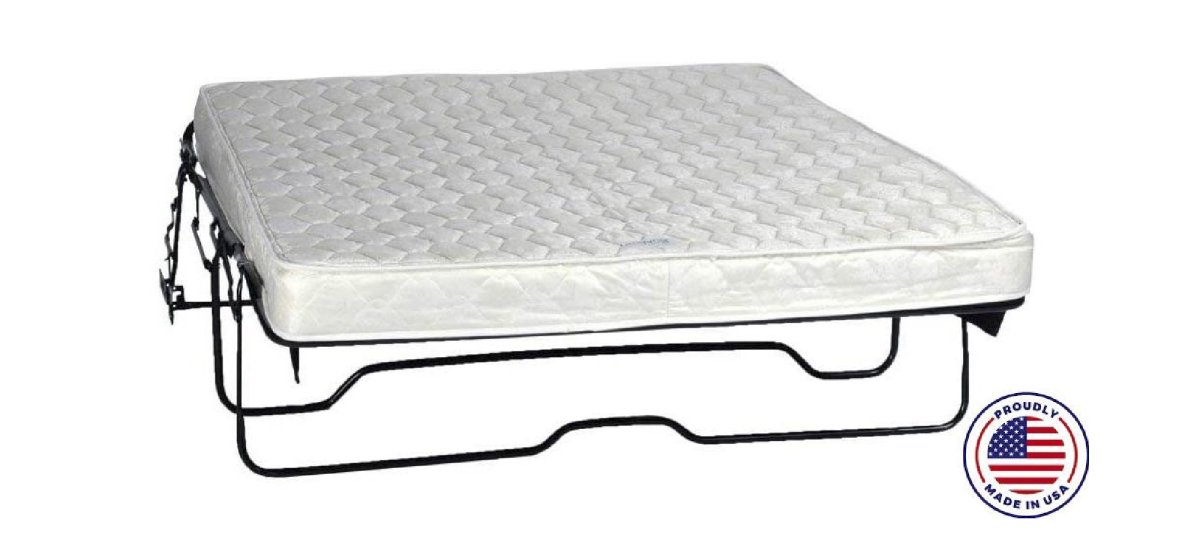
Square-tube versus round-tube construction is the other key durability variable: square tube resists twisting and flexing better under repeated load, which is why we build our mechanisms around square-tube frames.
Fire Safety Compliance for Commercial Seating in Guest Rooms
Fire safety compliance for commercial seating in guest rooms means meeting the flammability and fire-performance requirements for upholstered furniture in a commercial occupancy, stricter than home requirements and enforced at specification and inspection.
For the current text of the applicable codes and standards, check the National Fire Protection Association codes and standards and the Consumer Product Safety Commission upholstered furniture flammability guidance directly, and confirm local amendments with your AHJ.
Square Tube Frame vs Round Tube Frame Durability in Sleeper Sofas
Square tube frames outperform round tube frames in sleeper sofa mechanisms because flat sides resist twisting and bending under repeated load better than a round profile of similar weight, giving longer service life and fewer field failures.
| Frame Type | Resistance to Twisting | Typical Use Case | Service Life Under Frequent Use |
|---|---|---|---|
| Square tube | High, flat sides resist flex | Contract, hospitality, frequent use | Longer |
| Round tube | Lower, rolls under load | Light residential, occasional use | Shorter |
The frame profile matters more than the mattress for long-term durability: guests notice a worn mattress immediately, but frame twisting stays invisible until the mechanism is already compromised. Expect higher weight and cost with a square-tube contract mechanism, heavier steel, tighter tolerances, and a mechanism meant to be serviced rather than replaced wholesale.
Comfort, Mattress Thickness, and Sleep Quality in Guest Rooms
Sleep comfort in a contract sleeper sofa comes down to mattress thickness, support core, and how level the deployed surface sits. Guest complaints usually trace to three things: a mattress too thin, a basic innerspring core (memory foam and hybrid cores distribute weight better), and a mechanism that doesn't lock flat.
A mattress topper can extend an existing mattress's life and feel, but it won't fix a mechanism that doesn't deploy flat. Fix the frame and mechanism first.
Upholstery, Cleanability, and Maintenance Planning
Upholstery choice in contract furniture is a cleanability decision as much as a design one. Stain-resistant fabric handles spills and hides wear; leather wipes clean and resists odor but can crack in dry climates without conditioning.
Maintenance planning matters more than material choice: vacuum upholstery weekly in high-turnover rooms, spot-treat spills with the manufacturer's recommended cleaner, inspect mechanisms quarterly for loose fasteners and frame flex, lubricate per the mechanism manufacturer's guidance, and document issues for warranty claims.
Room Measurements, Space Planning, and Accessibility
Room measurements determine whether a sleeper sofa works in a given guest room. The three numbers that matter most are closed width, closed depth, and deployed depth.
| Measurement | Why It Matters | Planning Note |
|---|---|---|
| Closed width | Fits the wall run and traffic path | Leave clearance at each end |
| Closed depth | Keeps the room walkable | Account for seat height and back profile |
| Deployed depth | Prevents blocked egress and doorways | Measure to the far edge of the open bed |
For accessibility, plan clear floor space around the deployed bed and confirm the room still meets the accessibility requirements that apply to the property. Requirements for accessible guest rooms are set by the U.S.
Procurement, Installation, and Lifecycle Planning
Procurement for contract sleeper sofas works best as a lifecycle decision, not a one-time purchase. The cheapest unit at bid time often costs more over a renovation cycle once you factor in replacements, guest complaints, and downtime.
Specifying sleeper sofas for contract use means balancing durability, fire safety, cleanability, and room planning, and the mechanism is where most of that balance is won or lost. Hospitality Sleeper builds American-made, square-tube sleeper mechanisms backed by more than 35 years of experience and our exclusive Lifetime Service Policy.
Frequently Asked Questions
What does contract grade mean for sleeper sofas?
Contract grade means the sofa is built for commercial use rather than a single household. It covers heavier frame construction, higher cycle ratings on the pull-out mechanism, contract-grade upholstery tested for abrasion and stain resistance, and compliance with fire safety rules that apply to commercial seating. In practice, a contract-grade sleeper sofa is expected to survive years of frequent use across many different guests, not the occasional overnight visitor in a home.
Why are square tube frames preferred for high-traffic sleeper sofas?
Square tube frames resist twisting and flexing better than round tube frames because their flat walls create more contact area at every weld and joint. In a sleeper sofa, the frame carries the load of the seat and the pull-out bed, so less flex means fewer stress cracks and a longer service life. For hotels, motels, and vacation rentals where the sofa is opened and closed constantly, that difference shows up as fewer repairs over the renovation cycle.
What are the fire safety compliance standards for hospitality furniture?
Commercial seating in guest rooms is generally required to meet flammability requirements such as California Technical Bulletin 117-2013 for upholstered furniture components, and some jurisdictions add their own rules. Properties also need to keep fire safety labels intact on regulated furniture. Procurement teams should confirm which tests the manufacturer documents and keep that paperwork on file, because inspectors and insurers may ask for it during a renovation or review.